
A formal letter is one you write in an official capacity to someone you do not know personally: a company, a council, a landlord, a school, a solicitor, a government department, or a named person at any of them. Because the reader has no relationship with you, the letter has to do all the work. The layout tells them at a glance who you are and what you want; the wording decides whether they act. This guide covers the standard UK layout, the conventions behind each part, what to put in each paragraph and how the three common kinds of formal letter differ.
Index
- What a formal letter is for
- The guide: layout, conventions, content, application
- Templates and examples
What a formal letter is for
Almost every formal letter does one of three things:
- Makes a complaint: a product that failed, a service that was not delivered, a bill that is wrong.
- Makes an enquiry: asks for information, a price, a brochure, a decision or an explanation.
- Makes a request: asks the reader to do something, from a refund to a reference to sponsorship for a charity walk.
Decide which one yours is before you write a word. The purpose fixes the opening sentence, the amount of detail the middle needs and what the closing paragraph asks for. If you are writing to apply for a job, use the Cover Letters guide instead: the layout is the same but the content follows different rules. If the letter is personal, see Personal Letters.
The guide
Quicklinks
- Layout
- Conventions: addresses, date, greeting, sign-off
- Content: the three paragraphs
- Application: complaints, enquiries, requests
Layout
The example below shows the standard block layout used in the UK. Your own address sits at the top right; everything else sits against the left margin with a blank line between parts. Each part is explained after the image.
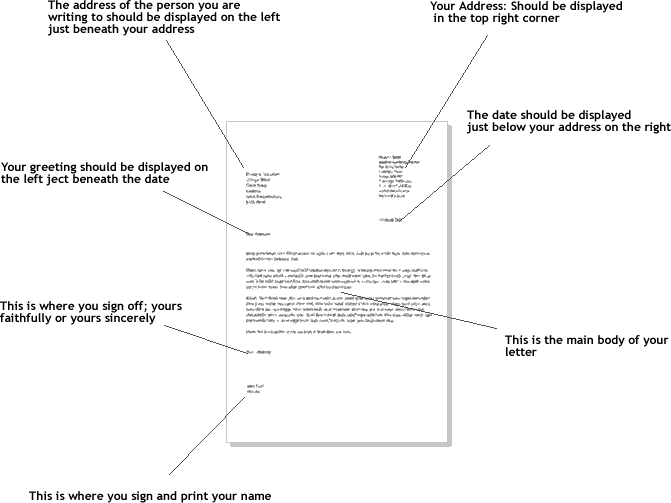
From top to bottom: your address; the date; the recipient’s name, job title and address; the greeting; the opening paragraph; the middle paragraphs; the closing paragraph; the sign-off; your signature; your printed name. Use a plain font at 11 or 12 point, no indents, and a blank line between paragraphs. One page is the aim; two is the most a formal letter should need.
Conventions
The conventions exist so that the reader can find what they need without reading the whole letter. Follow them and the letter looks like it comes from someone who knows what they are doing.
Addresses
Your address goes at the top right, one line per element, with no name above it. If you are attaching the letter to an email, keep the address: it tells the reader where to send a reply by post and makes the document complete on its own. An email address or phone number on the line below the postcode gives them a quicker way to reach you.
The recipient’s address goes on the left, below the date: their name and job title if you know them, the organisation, then the postal address. A letter to a named person lands on a desk; a letter to “The Customer Services Department” lands on a pile. The organisation’s website, a professional networking site or a short call to reception usually gives you a name.
Date
Leave a blank line under your address and write the date in full: 4 March 2026. Do not use figures only; 04/03/26 reads as 3 April in other countries, and a complaint sometimes has to show it was sent within a deadline.
Greeting
If you have a name, use a title and the surname: Dear Mr Patel, Dear Ms Okafor, Dear Dr Lee. Use Ms for a woman unless you know she prefers Mrs or Miss. If the name does not tell you the person’s gender, or you are not sure, use the full name without a title: Dear Sam Taylor. If you have no name at all, write Dear Sir or Madam. The old form “Dear Sirs” assumes the reader is a man and is out of date.
Sign-off
The rule is simple and readers notice when it is broken. If you addressed the person by name, end with Yours sincerely. If you wrote Dear Sir or Madam, end with Yours faithfully. Leave four or five blank lines for a handwritten signature if you are posting the letter, then print your name underneath. If your title or role matters to the letter, put it on the next line.
Content
Messages, social media and chat have made most of us write quickly and informally, and that habit leaks into formal letters without our noticing: abbreviations, missing capitals, jokes, half-sentences. A formal letter is read by someone who will judge your case partly on how it is written. Write in full sentences, in plain words, and keep opinions out of the parts that should carry facts.
The opening paragraph
Say why you are writing in the first sentence, and put any reference numbers there: “I am writing to ask for a refund for order 48213, delivered on 12 February.” The reader should know what the letter is about before they reach the second line.
The middle paragraphs
Tell the story in the order it happened, one point per paragraph: dates, amounts, names of people you spoke to and what was agreed. Say what you are enclosing. Keep it as short as the facts allow; a complaint may need more detail than an enquiry, but no reader thanks you for a page they did not need.
The closing paragraph
Say exactly what you want to happen and by when: a refund within 14 days, a written reply, a visit from an engineer, a copy of the policy. A letter that asks for nothing specific gets a vague reply. End politely: “Thank you for your help” or “I look forward to hearing from you.”
Application
Complaint
A letter of complaint goes to a person or organisation that supplied a poor service or a product that is not fit for purpose: a holiday that was not as described, a repair that did not hold, a delivery that never came. Give the facts in order, say what you have already done to resolve it, and state the remedy you want. Keep the tone firm and polite; anger gives the reader a reason to dismiss you. The Complaint Letter Template has the wording ready to adapt and explains how to escalate if nothing happens.
Enquiry
A letter of enquiry asks for information: a catalogue, a quotation, the terms of a service, whether a place is available. These letters are short. Say what you want to know, why if it helps the reader answer, and how they can reply, including an email address or phone number if you want a quick response.
Request
A letter of request asks the reader to do something: sponsor an event, provide a reference, grant an extension, make an exception. Explain the request in the first sentence, give the reader the facts they need to say yes, and make saying yes easy: a date, a form, a return envelope, a single clear question.
Templates and examples
The Business Letter Template is this layout as a plain-text template you can copy and fill in. Letter Writing Examples has four complete formal letters, two complaints, a request and an appeal, with notes on every part. For the conventions of written English beyond the layout, see Writing Conventions, and check anything you are unsure of against Spelling Rules in English and Punctuation Rules in English.
Formal and informal English: a short video
This video from an English-language teacher shows the difference between formal and informal wording in letters, which is useful if English is not your first language or you want to hear the contrast rather than read about it.